
QLmaterials

ABOUT QLmaterials

For Innovative Advanced Materials (IAMs) including Engineered Nanomaterials (ENM), even small changes in structure or surface properties can create new variants with different safety profiles. Testing every possible version in the lab can be costly and often unrealistic, especially when you need to compare many design options.

ABOUT QLmaterials

For Innovative Advanced Materials (IAMs) including Engineered Nanomaterials (ENM), even small changes in structure or surface properties can create new variants with different safety profiles. Testing every possible version in the lab can be costly and often unrealistic, especially when you need to compare many design options.

QLmaterials is a safety app for IAMs (including ENM). It uses machine-learning-based models built on curated experimental data to predict human-relevant toxicity endpoints. This lets you screen and prioritise material variants, focus laboratory testing where it is most informative, reduce costs and support safety by design decisions.

Use predictions to identify
which (nano)material variants
need experimental follow up

with token-based payment
- no subscription or
software download needed
regulatory-relevant endpoints
for better understanding the
safety profile of IAMs

Explore “what if” changes
digitally and move towards
safer-by-design IAMs

predictions based on
properties that matter for
advanced (nano)materials

Cut the number
of (nano)material specific studies
and shorten decision-making

Who is it for?

   R&D teams
  when you need a view on potential toxicity of new IAM                  before committing to full testing

   Toxicologists and safety assessors
  when you have to compare multiple IAMs options
  and build a safety argument

  Regulatory and registration teams
 when you prepare documentation and want in silico                     evidence to support your testing strategies

  Innovation and SSbD teams
 when you need to explore design changes to bring       
 safety into materials development

  01

Choose and endpoint &
specify the cellular model

Regulatory-relevant endpoints include:
mutagenicity,
genotoxicity,
pro-inflammatory responses,
for cellular models such as:

  02

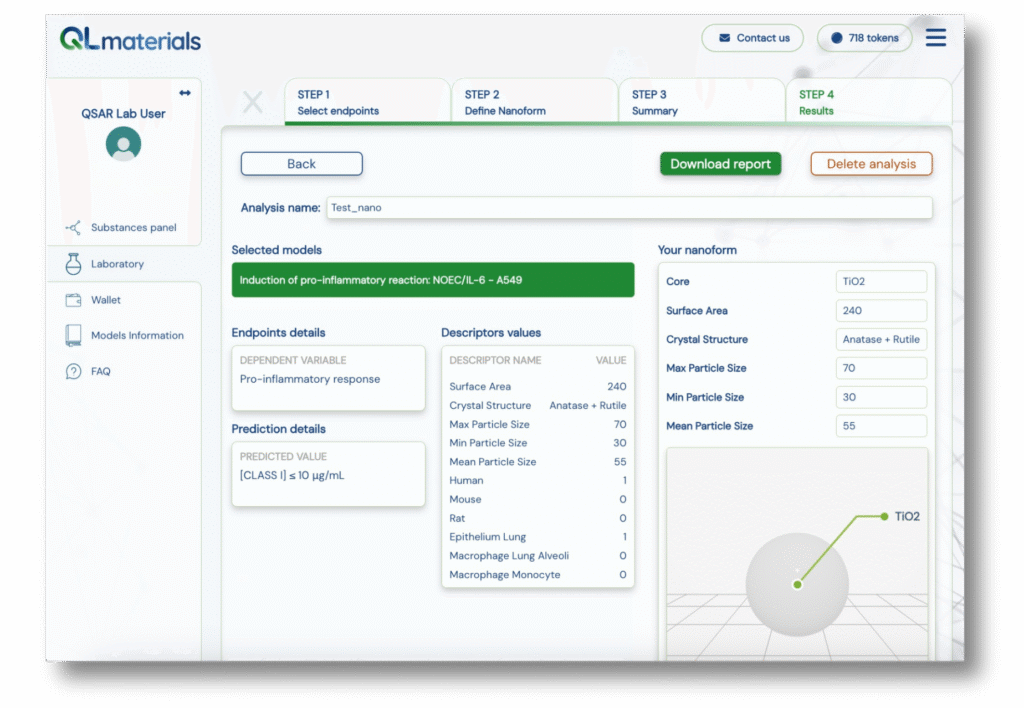
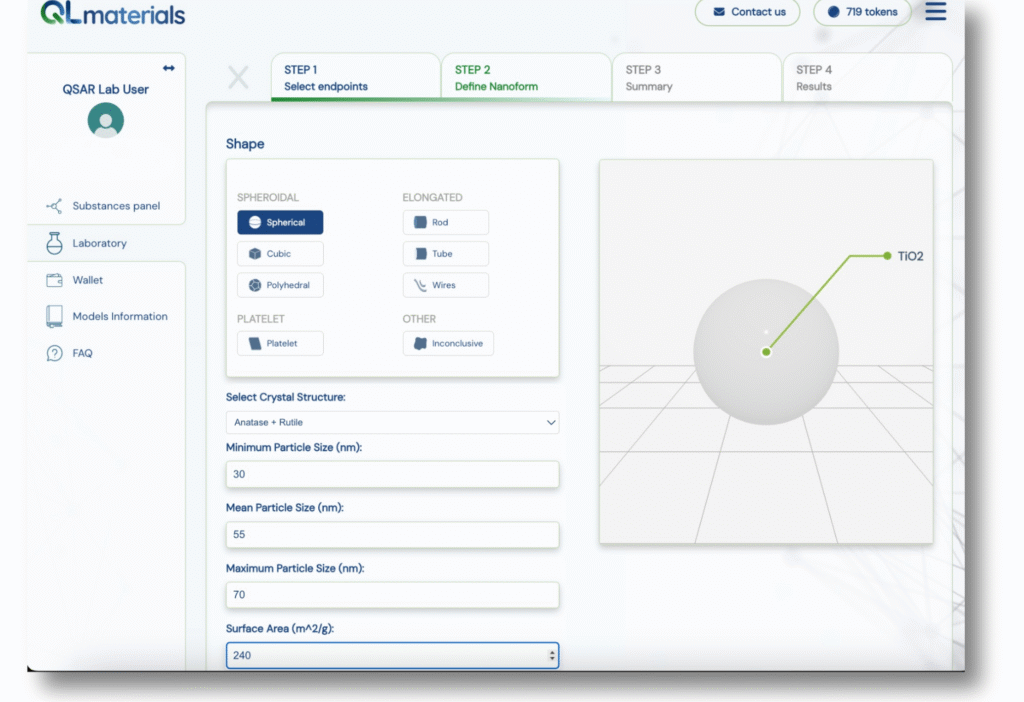
Define material &        run prediction

Set different physicochemical parameters of a (nano) material such as particle size distribution, shape and crystal structure.

Only one click is required to make the prediction – no specialized chemoinformatics knowledge is needed.

  03

Generate registration supporting report

Generate a tailored report aligned with relevant regulatory requirements, so you can directly use it in your safety documentation.

The report includes:
a detailed summary of defined material,
prediction result, description and scope
of its reliability, methodology used,

QSAR Prediction Reporting Format standard in line with OECD ENV/CBC/MONO(2023)32 guidance.