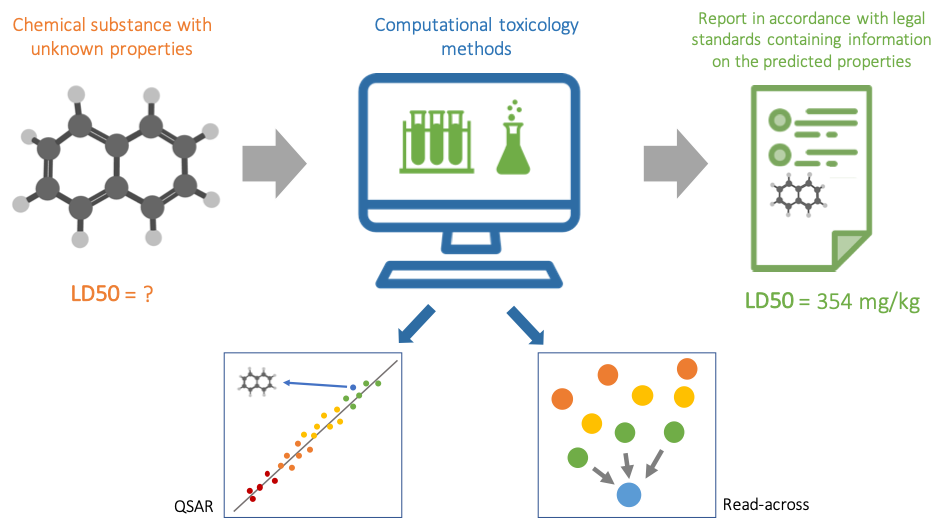
Modern computer-based methods of toxicology and safety assessment are built on the assumption that there is a correlation between the chemical structure of a compound and its properties, including biological activity. Computer methods are becoming an increasingly important tool offering both financial and business benefits. They enable significant cost reduction resulting from greater efficiency – large sets of substances can be analyzed in a shorter time. Moreover, alternative methods fulfill the condition described in the REACH Regulation (EC 1907/2006) regarding reducing unnecessary animal testing.
The experts at QSAR Lab have years of experience in computer toxicology, including the utilization of Quantitative Structure-Activity Relationship (QSAR) methods and Read-Through (RA) to predict the properties required for the registration of chemical substances and nanomaterials.
The QSAR Lab’s offer in the field of computer toxicology includes:
Analysis using computer methods to estimate biological activity and/or properties of a chemical compound/(nano)material, along with preparing documentation for the conducted analysis that complies with REACH requirements.
Support for R&D projects: – Expert consultations to precisely identify research problems and assistance related to the use of computer methods in the presented projects – Subcontracting of R&D tasks.
The weight of evidence process for assessing virtually any in vitro and in vivo toxicity endpoint.
Support for substance registration processes according to the REACH regulation through computer-based prediction of properties described in Annexes VII-X.
Używamy plików cookie, aby zapewnić najlepszą jakość korzystania z naszej witryny. Jeśli będziesz nadal korzystać z tej witryny, zakładamy, że wyrażasz zgodę na korzystanie z nich.